Sunday, 23 March 2014

Unit 37: Keyboard Skills - Task 2 Write-Up

The keyboard is an instrument laid out like a piano with black and white keys representing notes ascending in pitch from left to right, so low notes are on the left and high notes are on the right. All white keys are notes C, D, E, F, G, A and B, the black keys are sharp's or flat's of the notes they're next to as they're a semitone different in pitch, so the first black note to the right of C is C sharp or D flat, as it's a semitone above C and a semitone below D. An octave is when you reach the same note as the note on which you started, so C to the next C is an octave, and the 2nd C is an octave above C. Typically MIDI keyboards begin and end with a C note, and have five C's altogether, referred to as C1 to C5 in MIDI terms in the sequencer. The function of a keyboard is to allow you to play notes or chords, and a MIDI keyboard as a MIDI controller has no sounds of it's own, it triggers sounds in a sequencer and software plug-ins to play by transmitting MIDI data generated from the player pressing keys on it. This is the fundamental function of the keyboard, as to anyone with basic piano or musical knowledge it presents a relatable way to trigger notes of a virtual instrument that they may not otherwise be able to control with ease, and also the fact that any virtual instrument from drums to melodic instruments can be triggered or played on the keyboard is a big advantage for working quickly and simply.

A MIDI keyboard has features to control sounds in the sequencer. Firstly a modulation wheel can control parameters of a sound like vibrato, phase or tremolo. Turning the wheel from O-128 MIDI steps   turns this modulation from off to full, and the steps inbetween apply reletive amounts of the modulation to the sound. A common example of modulation being used to make a virtual instrument more realistic is vibrato on a violin instrument, as vibrato is what simulates a skilled playing technique where the players uses their bow to make the violin string vary in volume and tone by subtly varying the pressure they apply to it. Without vibrato a virtual violin sounds like a constant wave, and transition between notes and even the notes themselves sound unrealistic, whereas with the vibrato it simulates a real violin far better. Another keyboard feature is the pitch bend, which can move a note a tone higher or lower gradually, as the bend goes between notes as it bends.

Playing techniques for keyboard are as follows:


  • Scales - Playing a scale is where you play eight notes which make a musical scale with your right hand, playing the first three notes with your thumb and first two fingers then stepping under with your thumb for the fourth note and using your four fingers for the last four notes to complete the scale. Once you can play the scales you can devise melodies to use in songs, which I have done in my finished track. To make the melody I established the scale from the key my songs was in, and decided which notes sounded nice at which points over the chords I had to make an interesting melody, with different spacing between notes and some trilled or tripped notes to add interest or groove.
  • Chords - Chords are where you combine notes from a particular scale and play them simultaneously. The common chords are triads which consist of the root note, and the third and fifth note of the scale, which is defined by the root note. So a simple example is a C major chord which made of three notes, C (the root note) E (the third note of the C major scale) and G (the fifth note of the C major scale). These notes combined create the C major chord. I've used chords in my composition which are more complex than triads as I added more notes of the scale to them, like seventh notes and lower octaves of the root note with my left hand.
  • Arpeggios - An arpeggio is taking the notes of a chord like the C, E, G of a C major triad and breaking it up, by playing the notes in sequence to a certain rhythm which makes a melody out of the chords notes. I've used an arpeggio in the bridge of my track, where I've taken the notes of my keyboard chords and made a rhythmic melody line out of them, beginning by playing the notes in sequence like a scale, then playing around with them.

Unit 36: Studying Music from around the World: Task 1

Anastenaria Festival
Anastenaria is a religious festival celebrated annually in certain Christian communities in Greece. It's a festival in which people run across hot coals carrying an ancient icon or tablet, to secure blessing's from a saint named Constantine. It's a ritual with Pagan origins, which explains it's relation to fire, both signified by the hot coals and the bonfire and the dancing in circles that create a typically pagan ceremony. This ceremony is controversial with certain orthodox Christians in Greece, but for those who partake in it they believe they're honoring Saint's they worship in doing so, and it will heal them of ailments and purify them giving them protection. The icon they run across the coals with was saved from a fire in a church, and those who saved it got out of the fire without injury, so the ceremony is a sort of symbolic re-enactment of this event too.

The festival is accompanied by it's own ancient folk music, which is played at the beginning of the festival and during the ritual when people cross the hot coals. It consists primarily of repetitive melody played on ancient string instruments closely replicating a Greek Lyre, and a constant pounding singular rhythm which rarely breaks into any poly-rhythmic grooves or change in pace, and this is played on large boomy drums like a primitive tympani drum, which will be so it's easy to hear the beat or rhythm and keep dancing to it, and the volume also makes it more of overwhelming sounding to highten the spiritual atmosphere. In Anastenaria the melody of the lyre stays virtually the same for the duration of the piece, or uses the same notes in repetition throughout like an indian raga would. The music and rhythm are constant so it can be danced to for long periods of time. It contrasts with Bali though, as although this is music of Indian origin, its focus is far more on providing rhythm for the dancers, and the only melodic instrument involved is bamboo flute, as the compositions centre around the rhythms.I believe from footage of Anastenaria I've seen that the key instrument is a Chelys which is a relative of a Lyre, but is bowed and gives a sort of fiddle sound. It isn't possible to draw a certain conclusion as instruments maybe bespoke, but share similarities with this instrument structurally and sound wise. Along with this and the percussion from large drums, there is singing and chanting, which would consist of spiritual or religious lyrics, possibly even paraphrasing biblical quotes given the purpose of the ceremony.

Below is a link to a field recording of an Anastenaria field recording from 1979. In the recording you can hear other noises apart from the music like Goats and engines sounds presumably from nearby motor vehicles, but the main sounds in the recording are the fiddle sound from the Lyre type instrument and bassy drum which is similar to a timpani drum in classical music. The melody of the Chelys is repetitive and rarely changes through the nine minute recording, but this is because the function of the music is to support the fire walking and create the carnival atmosphere to encourage the fire walkers, not to be the focal point of the ceremony. 

Anastenaria Field Recording

The music of Anastenaria differs vastly from Bali as it's relies far less on a complex composition, and instead it's key components are repeated continuously and this maybe to create induce a sort of bliss experience and hightened emotional experience from the drone and repetition and chanting evoking this affect. Bali has many musicians in an ensemble which isn't much smaller than a western orchestra, where as the performers of Anastenaria are smaller ensembles, who provide the music to assist the chanting and fire walking proceedings rather than being the focal point. Bali is all about entertainment and has no religious connotations like Anastenaria, so this explains the differences plainly. It also differs from the Brazilian samba or carnival music is this too has no religious relation, it's just a communal celebration. The music of carnival and anastenaria shares similarities in it's heavy percussion leading the rhythm of the proceedings, but this is the only similarity between the two events, everything else is contrasting.

Bali Recital 
Bali is music originating from the island of Bali, which shares similarities with music from neighboring countries and cultures as it is a province of Indonesia, and therefore shares similarities with Indonesian culture. The music of Bali known as Gamelan is a music which is native to many close countries like Indonesia and Sudan, but Balian gamelan suits its own purpose, specifically for its own cultural events. Gamelan is music performed in large orchestra's on tuned percussive instruments like xylophones, metalaphones, flutes, drums and gamelan gongs. Mostly, the instruments are metalic like the gong and metalaphone, and these are played with wooden or metal hammers depending on their octave, which is wooden hammers for low octaves and metal ones for high octaves. A wooden hammer will produce a duller hit with less attack as it isn't as dense as metal, and rounded edges will lessen this impact on a hit, but this will balance out with the sharper louder high notes as the bassier notes will have more energy, travel further and only act to reinforce the melodies so don't need to be the loudest part of the gamelan orchestra. The instruments in a Gamelan orchestra together cover 7 musical octaves, and though they're tuned they aren't tuned precisely to a musical key or to each other which creates an interesting phase sound when melodies are played simultaneously across them, and as a result are more distinctive as seperate voices than they would be if exactly tuned and the compositions sound bigger as a result, and have interesting musical imperfections from these different notes, despite the mechanical precision with which they're played by the orchestra. The compositions are structured in an apparently random arrangement of rhythms with varying rests and syncopation of notes. Some short phrases will be played the same by all sections of the orchestra, then there maybe a rest which emphasises the impact of the sound when it returns, and when there is a longer phrase it then contains more complex variations, poly-rhythms and melody changes creating incidental harmoniesd between the sections of the orchesta. Also phrases can contain the full orchestra, and then the next phrase may on have one musician playing, which provides contrast and is a call and responses technique between members of the orchestra. The gongs and drums emphasize the stabs of sound, and add weight and power to them. In Bali, there are interesting variations across the island in how instruments are made and played, indicating that in different villages they separate themselves and form their own communities doing things their own ways. Different materials create different textures, meaning the music isn't exactly the same sound from place to place, which sets it apart from carnival music and Anstenaria as these broadly adhere to the same sound.

The music of Bali can serve several purposes, as accompaniment or as the main component of a performance itself. A performance of just Bali's music will be a complex rhythmical composition, with short complex rhythmical phrases and varying rests between them creating an interesting and varied sound. Techniques like call and response between parts of the orchestra, and solos of instruments are used in recitals, adding variation and interest to the pieces. Each section of the orchestra has to be accurate with their timing, and remembering of the composition for the effect of the music to completely work, as the staccato hits need to be simultaneous from all performers to emphasize the sound of the orchestra. I've not seen any sheet music during a recital, so I therefore assume it is learned and passed on by demonstration and word of mouth, which is similar to how traditional Indian music is kept alive. Anastenaria too will use this to pass the music down. Culturally this type of performance serves only as entertainment, and has no further spiritual connotations. All the performers are dressed in a uniform and are male, which suggests there a established roles for each sex in the performance, and the uniform suggests pride in there position in the orchestra, and that they all dress the same for the visual element of the performance. 

Then there are Bali performances which see the orchestra providing a typically slower musical accompniment for dancers, who become the focal point of a performance. They dress in flamboyant clothing, and portray characters in a story, in the case of the performance from the David Attenborough documentary linked below the man and woman in the dance are enacting a "man meets woman" story, but acting it as bees, so their expressive movements are supposed to give the impression of them being bees, and attributing human characteristics to the way bees act, like a form of anthropomorphism. 

Finally another Bali recital that takes from both of these is a piece completely vocal ensemble piece called a Ketcha chorus, which is intended to bring on a spiritual experience with it's intense and constant chanting and frantic dancing. Many older religions sight chanting and/or mantra's as a way to evoke spiritual experiences, like Buddhism or the international society for Krishna Consciousness (Hare Krishna). This chorus is an incredibly loud and intense performance, but isn't really for spectators but for people involved, and the volume and intensity is probably what creates what a person describes as a spiritual experience. 

Bali differs from Brazilian carnival music and Anstenarian music as it has many branches of sounds off it rather than just one type of music, so is more varied in sound and purpose. It's also the only one of these with a totally vocal performance, as each of the others use instrumentation, and Brazilian Carnival rarely uses vocals altogether. Below is a link to a documentary showing all the Bali recitals I referenced in this writing.

Bali Music Documentary & Recital

Brazilian Carnival
In Brazil, carnivals are one of the largest celebratory events that take place annually across the country. It's time in the year is before Ash Wednesday, which is a religious day in the Roman Catholic belief, but now a days the festivities have little relation to this. Carnivals are events where people parade through the streets, either walking or dancing, but always in colourful dress. The largest carnivals take place in the Brazilian capital of Rio De Janeiro, and are now a globally known event, that people travel there especially to witness. 

Samba music is the music of the traditional carnival, and has a distinctive South American groove provided by rhythmic drumming on large drums called surds, use of metallic percussion like cowbells and agogos, and additional percussion from shakers called Ganzas and whistles also providing the carnival atmosphere. Not all regions of Brazil have the exact same procedure for their carnivals, for example in Rio the main carnival is supposed to be watched, and then smaller sections of the parade allow for public participation, where as in Northern regions everybody walks with the carnival. In the North of Brazil there are ties with Africa, as African's have migrated there over time, so Samba music has roots in African music as well as Brazil, which explains the origins of the heavy rhythm and large drums that are a staple of African drumming music. Samba has ties with flamenco guitar though also, so is a very broad genre of music, with lots of samba being composed and played in a 2/4 time signature which is half the time of 4/4, which gives it urgency and quicker melodic changes. For the amount of drums and percussion in the parade there is a conductor who leads the samba schools, giving indication to when solo and polyrhythms are, and basically ensuring the drumming doesn't turn into a big disorganised noise, and retains the rhythm. This music accompanies the parade, providing the rhythm for dancers to dance to, and sets the tempo for which the precession travels through the streets. The fusion of rhythm from African drumming, specifically Batuque which is in Cape Verde (an island of the Western coast of Africa) and existing Brazilian music using classical guitars, some smaller percussion and shakers, gives it a multicultural appeal and mixed heritage, making it an event for everyone including Brazilians.

Like Anastenaria, Carnival has it's roots in old pagan religious ceremony, and also shares similarities in the heavy rhythm for the participants of the event to move to, but apart from that there are very few similarities, as the slight religious tie in Carnival is now virtually removed from the event. Similarities can be found between Carnival and Bali in the appearance of the participants. As both events are a form of entertainment, the performers in both wear very colourful clothes to show the importance of the event, and make for a more interesting show. Another similarity would be that whole communities watch or take part in both events, making them a communal relationship builder.  

A side from this there aren't many more similarities, and the largest difference is the scale of Carnival compare to the other two events, because of the size of Brazil and it's vast population. Bali is a small island, and although it's music is practiced across it, it's nothing like the scale of Brazil's carnival, and also Anatenaria is frowned upon by some sections of Christianity in Greece making that quite a small event as well, so Carnival is by far the biggest event. Also, carnival is the only one of the three to have spread from its native home and be adopted by events around the world. This is probable due to it's celebratory vibe, and removal from any exclusive religious background needed to take part, making it a format that many people can enjoy and feel a part of.


Unit 35: Sound Creation & Manipulation - Piano Sampler Video


Saturday, 22 March 2014

Unit 2: Audio Engineering Principles - Audio Engineering Terminology

Below is a list of definitions for audio engineering terminology. These are important to know for recording music to get high quality recording's without faults to prevent problems when mixing and mastering.

Sample Rate - Sample rate refers to the amount of times per second a "sample" of an analogue signal is taken to create a digital recreation of it. This relates directly to the conversion of analog signals to digital, because digital sounds are made up of multiple sections of samples from the analog signal, put together to form a sequence of samples that makes the sound of the analog signal when played. The difference between analog and digital versions of a sound therefore is that the analog signal is a constantly changing waveform, whereas the digital version of the same sound would have gaps in between samples where no information is taken so the completed digital recording has visible steps between taken samples when closely analyzed. This however is inaudible if the sample rate of a recording is high enough, and you'd have to zoom very far into it to see this as a high sample rate means more samples are taken per second to form a more detailed, and therefore accurate representation of the analog formation. Sample rate is measured in hertz because of it's relation to waveforms. A complete cycle of a wave (from peak to peak or trough to trough) in exactly a second would give the wave a frequency of 1Hz, two cycles a second 2Hz and so on. So when sampling a waveform, it's the equivalent to re-describing it's frequency and it's content at that particular moment, meaning that multiple samples in the duration of it's one cycle would probably give a quite accurate recreation of it, whereas one sample may only take the section where the wave crosses the zero amplitude line which would represent silence, so the reason sample rate measures in hertz is to show rate of samples being taken to show this wave per second. It's suggested that 48,000Hz is an ideal sample rate for digital recording, so if you're recording a wave of 12,000Hz in frequency, you will have taken four samples of the wave per cycle, which will result in samples of varying amplitude and give an accurate representation of this analog wave. This is where sample rate ties in with the Nyquist theorem, which basically suggests all signal conversion should have a conversion rate of double the highest peak in frequency of the sound it's converting. This would be prevent an occurrence similar to like I mentioned earlier where not enough samples of a sound were being taken to accurately recreate the sound, which is also a basic description of aliasing which I'll talk about later. This theorem is applicable for recording music with digital equipment, and is also put into practice in manufacturing CD's, where this theory is adhered to bouncing audio to 44,100Hz and 16bit as it doubles the range of sounds within the range of human hearing, and should theoretically eliminate aliasing.

Bit Depth - Bit depth is the other variable alongside Sample rate which defines the quality of a digital recording from an analog signal. Where the sample rate refers to the amount of samples taken, the bit depth applies to the detail of each of those samples, according to the amount of volume levels the sound can be interpreted as being at. By this I mean, if the bit depth is low, it sets less possible volumes for the analog waves amplitude to be determined at, so as a result the sample would be rounded up or down too severely and not sound like the original signal. However if the bit depth is higher and there are many stages that the sound can be, then this won't occur and each sample will be at a similar level to the analog one, resulting in an accurate sounding recording when played back. 16bit and 24bit are two options for a recording bit rate but the difference between the two is vast. In 16bit recording there's a possible 65,536 levels to describe the volume of a single snapshot of audio compared to 16,777,216 at 24bit which means far more accurate placement of a sounds volume from amplitude and positioning of the sample in a digital wave recreation. A lower bit depth equates to a poorer sound quality and sound to noise ratio as with less steps to describe volume, there can be unnecessary exadurations in low level noise typically received as a hissing sound by our ear which tarnishes the sound. Here's a diagram giving a visual representation of samples and bit's on one graph of a wave. It shows a smooth sine wave which represents the analog wave and the digital recreation of it comprised of samples of a certain bit depth. It acts as a good visual representation of these two principals, however it's showing a sample rate and bit depth of far less than you would feasably record at, but if we assume the effect is similar for high bit depth and sample rate, just far more detailed than this to the extent that we may not see all the steps at this sort of distance of a wave.


 dBfs - dBfs is an abbreviation for decibels full scale and is the upper most limit of a digital recording system where a recorded sound becomes clipped. A clipped sound is one that has exceeded the volume threshold of the digital recording device by having too large amplitude which relates to volume. A clipped recording is unusable as the sound of clipping is a very unpleasant atonal click or pop which can't be hidden in a multitrack, and cannot be fixed with  any sort of editing. This is what makes digital levels so important to adhere to, to prevent any signals clipping during a recording. Firstly, its recommended that we record at a project rate of 48,000Hz and 24bit depth. We can record at higher than 48,000Hz but the difference isn't massively audible and the forfeit is that the project has a massive file size if we go up to 96,000Hz for example. The 24bit depth is more important though in relation to dBfs, as it defines the stages of levels we have to use as headroom, which is the available signal level space between the peak of the signal and the threshold of the recording device. At 24bit, as we have so many more stages to describe the sound accurately, there's a knock on effect that there is far more available space in stages above the signal to use if necessary, but at 16bit the less stages mean signals are rounded to higher steps, with even less steps above them to go to if the sound volume increases, meaning it's far easier to clip at 16bit with inattentive monitoring of levels, or a poor setting of levels to begin with. When setting levels the engineer would check the sound coming into the desk wouldn't peak at the loudest the performer would play by asking him to do so, to check that it was below the threshold. Also we can set a project reference level at a recommended -18dBfs, as this allows for movement in volume and for signals to peak up around -10dBfs and still have headroom with the signal to noise ratio being bad. The signal to noise ratio is another thing sorted when setting levels, as when you boost the gain to near the threshold of the desk for example, you are getting a manageably loud signal without low level noise being audible. 

Binary - Binary is a language consisting of zeros and ones that can prompt a computer to perform tasks depending on the sequence and amount of zeros and ones in the message. It's relation to digital music and recording is it's relation to MIDI data, which uses binary to translate messages from a MIDI controller device to a computer. Alan Turing is the person responsible for first using binary as instructions to operate a computer in the late 1930's, though it was invented century's before this.

MIDI Messages - MIDI messaging is a language where data can be generated and sent to a computer that can interpret it in order to create a certain sound with certain characterists when being used in a musical context. It has a range of 128 values which equate to options for how to represent the sound its recreating, for example 128 different velocities that a note can be, 1 being as soft as possible and 128 being as hard as possible, and the others inbetween being varying degrees of velocity. This is applicable to anything MIDI can control, so volume, pan etc. These controls are from continuous controller MIDI, which is specifically to control these types of functions. MIDI messaging can be creatively used in music production to trigger external instruments like synthesizers. An example of this would be to emulate a synth with a 16step sequencer by making 16 MIDI notes of equal length across a 1 bar region in a sequencer, and sending it to a synthesizer to trigger it to play in this way, which would be impossible for a performer to do accurately. These notes could be pitched up and down in the piano roll of the sequencer to create either a melody in a lead or bass synth, or to trigger different percussive elements in a percussion synth.

Digital Theory - Digital theory is a broad title for all the stages and considerations for converting analog signals to digital signals without altering key characteristics or damaging files. It relates very closely in parts to sample rate and bit depth, and also the Nyquist theory. Much of digital theory has come from research in other areas like telecommunications and radio transmission, which have coincidentally provided information for digital music. The key areas of digital theory are in the conversion, so the sample rate and bit depth are key, but also the project rate of 48,000 Hz and 24bit standard are an important platform to ensure that sounds are being converted at a high fidelity. Also there are considerations after conversion like those below, of dithering and aliasing. There are the obvious benefits to digital audio over analog, the key being that digital audio cannot degrade in storage or usage. A master tape kept in a volt can naturally degrade after a period of time, which is why many classic albums from the 50's to the 70's have had recent digital conversions from old analog tapes to stop them ever being lost. Also these digital files can be more easily manipulated than tape, which allows for more advanced mixing, and also remixes of songs too. 

Dithering - Dithering is a process which occurs when music is being converted to a lower bit rate after mixing and mastering like when converting to the redbook standard of 44,100Hz and 16bit. It is an addition of low level noise which we would perceptive as nothing more than slight hiss, which is there to mask an unpleasant sound that can occur from changing bit rates, as the sound are rounded to a less specific step than they were recorded at. As I mentioned in the bit depth section, digital sound has steps to describe it, with 24bit having more steps so more accurate description, but moving to 16bit removes some steps meaning the sound may be rounded up or down and as a result sound distorted or sonically wrong as a result, so the addition of the low level noise helps to smooth this problem. Also when a song is faded in or out, it may loose the low volume stages to describe it, and be rounded to zero or no sound, which would spoil the fade in/out, so dithering combats this issue also by ensuring there's always a low level sound to be registered so nothing is lost altogether.


Aliasing -  Aliasing is a problem like Dithering that occurs during converting to a different size or sample rate and bit depth when bouncing. It's when sounds appear to become merged and false audible information is suggested, which can sound unpleasant or generally muddy a mix. It's a direct result of not enough sampling at constant intervals, which suggests that sound is behaving in different ways than it is, whereas in actual fact frequent sampling should recreate a typical looking sine wave, but if it samples at intervals which don't keep up with the cycles it make take samples of too many crossings of the 0 amplitude line, suggesting the signal is quieter than the original mix because it only has the quiet samples. A more easily understandable analogy is that of the one spoked spinning wheel, where taking infrequent samples may suggest the wheel is spinning the opposite way that it is because the samples are an over rotation so it looks like the spoke is spinning one way when in fact it has just done more than 360 degress since the last sample. In the analogy our eyes seeing the spoke are the equivalent of the samples being taken, and the spinning wheel is the wave form.


Oversampling - Oversampling is where data is sampled at the frequency recommended by the Nyquist theory of double the consistent bandwidth frequency or greater than it so that the sampled audio perfectly recreates the analog one. Oversampling therefore should prevent aliasing, because samples taken as frequently as the Nyquist theory indicates means that no important samples can be missed to describe a wave form, so there are no gaps in the wave that take away from the quality of the sound.

Error detection and Correction - Error detection and correction is when data mapped to a disc contains information that relates to the data around it to amend any data faults that may occur from faulty data, or disc. The lazer checks the data is matching how it should be, as guided by the other data, so when a fault is detected it can begin to amend it using the similar data before and after the corruption which suggests how it should look when it's right.


Tuesday, 18 March 2014

Unit 37: Keyboard Skills - Task 2

Screenshots of each different drum beat, percussive phrase and melodic phrase. Beneath those is my finished composition containing these parts, and featuring techniques like arpeggiation, pitch bend, modulation, dynamics and melodic composition.


Unit 37: Keyboard Skills - Task 1


Friday, 7 March 2014

Unit 10: DJ Skills - DJ Equipment Setup (Performance Techniques)

Unit 10 - DJ Performance Techniques

DJ Equipment Setup
In this assignment I’m writing about the type of equipment that would be used by a DJ who specialises in blending tracks, beat matching and playing records to an audience to both entertain them and educate them with the continuous flow of music. These DJ’s may use vinyl records, CD’s, MP3’s and serato software and hardware to play their music, and they may infact use more than one of these things incase something brakes, or if they want to play a track they only have in a certain format. I will write about each of these, as well as crucial equipment that goes with it for a DJ to put on a show, and then discuss the features of these pieces of equipment and finally an evaluation of how well certain equipment works in it’s field and compared to its competators.
Vinyl DJ Setup: 
A DJ playing vinyl records from their own collection would have to bring all the music they wished to play that night to the venue with them, which may be restricting as they can’t take everything they own due to the size and weight. They would need two turntables, so that while one record is playing they can cue up the next one and move from one record to the other seemlessly. Another piece of equipment needed for this is a mixer, which sits between the two turntables, and contains the neccessary controls to move between turntables, and add effects to the sounds. The other equipment they’d need is a pair of headphones to plug into the mixer, so they can hear the record they’re preparing to play without it being played to the audience. Also they need monitoring equipment so they can hear live sound without any delay or altered sound, and this would come from a booth monitor facing them. It’s important for the DJ to have a reliable reproduction of the live sound, so they know that when they match the beat of the following record to the live sound it will definately be in time and sound right to the audience. Usually the larger equipment like the booth monitor, mixer, turntables and an in house PA system will be provided by the venue, so the DJ would only be responsible for bringing their music and accessories like headphones etc. The equipment provided would be industry standard, so there wouldn’t be any complaints from the DJ, or any problems that would affect the sound quality. An example of industry standard turntables are Technics SL 1210. Important features of this turntable are:
  • Direct Drive - The platter of the turntable is rotated by a direct drive motor, which responds to an alteration in speed by a DJ touching the record far quicker than a belt driven turntable would. This is important as when the DJ is finding the point of the record where they want to drop it in, it has to be procise and on beat, so it murges with the previous track properly.
  • Counter Weight - This is a weight on the end of the tone arm, which is adjustable and varies the weight of the needle on the record. This can stop the needle bouncing around loosly on the record, which is more useful for a scratch DJ, but still important if the vinyl is a lighter weight, or has lots of music packed onto one side as this can often compromise the depth and width of the grooves making them easier to skip between.
  • Pitch/Speed Accuracy - It has a strobe which shines onto a pattern on the side of the platter, which guides you to getting the speed perfectly at 331/3 or 45 rpm, by creating the illusion that the lines on the side of the platter aren’t moving.
It has a reputation among DJ’s as being a stable, well built and reliable turntable with all the neccessary features to use live. It also has standard features like a larger inner for records with a jukebox sized whole in the centre, and a large start/stop button which stops the rotation of the platter and allows the DJ to change the record. The only problem with the turntable is it has fixed RCA output cables, which means they aren’t supposed to unplug from the turntable, so if they break they can’t be replaced on the spot, like mid-show, and the turntable would have to be taken apart to replace them. This could definately be improved. These RCA cables are what connect the turntables to the mixer, where the sound signals are altered.
image
Here’s an image of the Technics SL 1210, showing some of it’s key features I descirbed. Many other turntables provide competition for this turntable, and many try to mimic its best features, but this turntable has a reputation as one of the best turntables, and this reputation sets it apart from its competition.
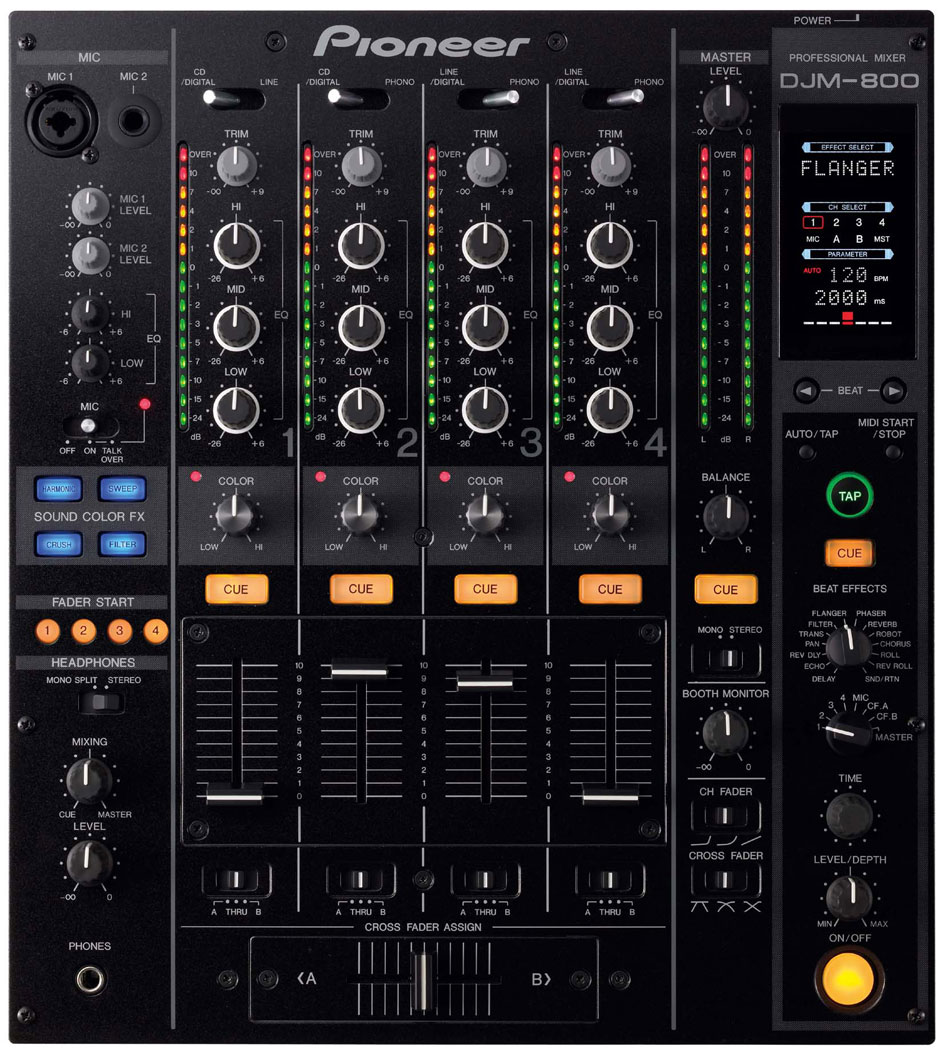
An example of a good mixer for a vinyl DJ is the Pioneer DJM-800. It does everything a mixer has to do,and has a simple layout and all the necessary features of a mixer. The mixer is used by the DJ to move between the two turntables, cue the upcoming track and EQ/Filter effects to the sounds to give their performance a unique edge. The most important features are:
  • Cross Fader - A basic fundamental component which allows the DJ to blend subtly between tracks on two turntables, or tracks on two CDJs/Serato time coded vinyl. When the slider is positioned fully left, the mixer is receiving signal from the left turntable only, and when fully right, receiving signal from the right turntable only. When it’s in the middle the output is a 50/50 split of the two decks, and during the performance it would only e there if the beats and tempos of the two tracks were matched and the DJ was transitioning from one to the other.
  • Channel Volume - Often with vinyl the volume of the pressing can vary depending on the amount of music one a side, the weight and quality etc. so the channel volume allow you to increase the volume of the signal from a turntable if it fluctuates between records.
  • 96KHz/24Bit Sampling - This is a high quality rate to convert the audio signals from the turntables to digital signals where effects and filtering can be added before converting the signals back to analogue to be played out of the PA system. The high conversion rate ensures the sound quality isn’t compromised from the original signal to it being sent at to the speakers. A mixer without this sample rate may produce a lifeless sound, despite having effects added to it.
  • Versatility - This mixer has four RCA inputs which correspond to the for channels on the mixer. This mean that equipment with RCA  outputs like vinyl turntables and CDJs can be connected to it, and because there’s four channels instead of two, two turntables and two CDJ’s could be connected at the same time. This means the DJ has many options for what they want to play next, and in which format they want to play it.
  • Additional Features - This mixer has other features which make the DJ’s life easier, for example the pots which control the digital effects light up which is useful as DJ’s often gig in dark rooms so this means they won’t accidentally add any wrong effects or on the wrong channels as the visibility will be better.
image
Below is a picture of the back of the mixer which shows its inputs and outputs. In the bottom left there’s a power input for a kettle lead labelled AC/IN, which gives the mixer power. There are 4 RCA inputs, labelled one to four, 2 of which are line/digital for turntables and 2 are CD/digital for CDJs. There’s also one RCA output labelled master which sends all the sound being processed by the mixer to the PA. There’s a L and R jack output labelled booth which is to send the signal to a booth monitor which is what the DJ listens to the blend the cued track in their headphones to. It also has MIDI inputs and outputs for digital hardware and additional equipment they may want to use.
image
For monitoring it’s important that the DJ can hear live sound, and headphone sound to match the tempo and beat of a track to the live sound, so it sounds right to audience when its introduced and keeps the flow of the set going. Therefore two crucial pieces of kit are a booth monitor and closed back headphones. The headphones would be property of the DJ, and although the DJ may need their own portable booth monitor they will often be provided by the venue. A good example of a portable monitor is a Mackie SRM-350 V2. Good features of this are its size and portability, as although many venues have or hire this equipment, they could be performing in a venue not accustom to live performance, where portability would be crucial. It’s a 2- way bi-amplified monitor which means it has a woofer for low frequencies and a tweeter for high frequencies and each has its own amplification. This means the signal it recieves is split when it arrives, so signals above the frequency level go to the tweeter and those below are sent to the woofer, and then the two are amplified seperately. This means the monitor works more efficiently as power isn’t being wasted giving more power to a tweeter that doesn’t necessarily need it. Another bonus is that electronic crossover is designed to prevent phase problems, so the sound is as clear as possible, and no sounds are cancelled out. These features set it apart from other speakers in the same price range, and at around £300 it is affordable for even smaller DJs to have this good piece of equipment to aid their performance. Here’s a picture of it.
image
CD/MP3 Setup:
Usually digital music can be performed using similar DJ equipment whether its on CD or an MP3 file, for example a digital mixer will often be compatable with traktor for MP3 as well as having inputs for CDJs, and often CDJs are capable of playing MP3 files giving them many options of what to use. Lots of this equipment derives from the vinyl setup that preceeded it, but because of the music being a digital format, not all vinyl DJ’ing equipment is suitable to use with digital music. The first thing is a CDJ, which is the equivalent of the turntable but plays CDs instead. It differs from a standard CD player as it allows you to control the music with a platter on top of the CDJ, imitating the technique you would use to scratch on vinyl, but in the case of a blend DJ, just to move the needle to find the start of a bar or section. This isn’t in direct contact with the disc which many vinyl DJ’s find they cannot adapt to, but it aims to give the DJ the same control over the CD as they had with a record on a turntable.
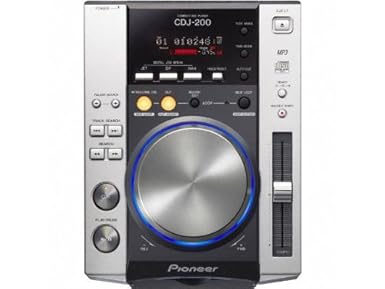
An example of a CDJ is the Pioneer CDJ200, which is a mid-priced CDJ with limited features but allowing you to do the same as with vinyl.
  • MP3 & CD playback - This means you can control either the CD in the player or MP3s in the library. All MP3s are laid out in folder view on the screen so they can be found quickly during a live performance. This works in conjunction with on screen information like auto BPM which aids the DJ getting the track in time and making a better blend between tracks.
  • Tempo Changing - There’s a tempo guide on the screen and three pitch lock settings on the tempo button which allow you to speed up or slow down your track to match the one that proceeded it, and then keep it at that constant tempo, and to prevent it going in the pitch it would’ve naturally changed to due to the tempo change, which could be out of a certain key and sound odd.
  • Jog Wheel - This is what simulates a record platter, and allows you to speed or slow down the track and find a position in the track in a hands on manner, with a similar action to putting your hand on a record and dragging it forward or backward.
  • Effects - These may not be important if the mixer has its own in built digital effects, but the CDJ has three effects of its own to play around with and alter the characteristics of the track you’re playing.
The CDJ is pictured below, and shows many of these features. Like turntables, they connect to the mixer via RCA cables, and also have a digital output for sending the signal to any other exterior processing unit, and it has a power input for a kettle lead to power it.

 An alternative digital sound source is to use Traktor software on laptops to play and manipulate MP3 files. This can be compatable with mixers specifically designed to use traktor, or other digital mixers, but two platters would still be needed to control the tracks, which are on some mixers. Traktor is less limited than a CDJ in what you can do to a track, making for a more creative performance and allowing the DJ more freedom. Also modern digital mixers have lots of built in effects that can be applied to the track in many different ways giving the DJ more creative freedom. An example of a good digital mixer with these features is the Pioneer DJM850, which has four channels, each capable of applying digital effects and EQ to the track, giving the DJ many options.
  • Channel Effects & EQ - Each channel has a pot labelled colour, which controls how much of that signal is sent to have effects added to it, and on the right of the mixer there’s a display showing information about the effect being added and pots to change the effect and also it’s level and how much it acts on the sound with a wet/dry control which would work for the reverb setting. Also each channel has a 3 band EQ, which means it can target at three different frequencies which would be a cut or boost of low, mid or high frequencies. This gives the DJ lots of options of how to manipulate the track.
  • Versatility -  A big selling point of a modern digital mixer would be its versatility, and how many functions it has. This has the ability to be used as a MIDI controller, so pots on the mixer could be used to trigger MIDI data that could control anything from a musical element, to a lighting display, giving the DJ yet more areas to explore to enrich their performance.
  • Sampling Rates - Like the vinyl set up mixer it has a 24bit 96KHz sampling rate, which means even if the tracks have effects on them they still are good quality when played out loud.
Here’s an image of the mixer. This mixer has a USB connection to something like a laptop to play the MP3 files quickly and easily.DJM-850K
Pros and cons of CD/MP3 setup:
One massive advantange of using MP3 is that the DJ doesn’t have to take their hole CD or Vinyl collection to a gig, but can have all the songs they want to play on one CDJ or laptop with external memory. Also digital music’s quality can be depleted by excessive playing or contact like vinyl can, so this means the files you have will always be fit to use in a gig.
However, many DJ’s may not like the disconnection of CDJ deck which isn’t in direct contact with the disc you are controlling, whereas with vinyl you are touching the disc itself to find the correct position in the track or match the beat which maybe be a more comfortable and natural feeling. Also there are instances where certain tracks are only released on 12” vinyl and not digitally, so if you desperately wanted to play one of these tracks you’d have to buy the record and play it that way.
Serato Setup:
Serato addresses the pros and cons of vinyl or digital DJ’ing and tries to create the best of both worlds by utilising the advantages of both. It uses pieces of vinyl with time code pressed on it, and this corresponds to digital files on serato software on a laptop, meaning that these MP3s can be controlled by the moving of the vinyl, giving the DJ the comfortable feel of manipulating the timing by touching and dragging the vinyl, but doesn’t wear out as the music is an MP3 file, and means the DJ only has to ever carry two pieces of vinyl. The other piece of equipment needed is a rane box which acts as an interface between the mixer and the laptop and will convert signals between analogue and digital, send the MP3s from the serato software to the decks and then out of the speakers and also is responsible for making sure the MP3 files are responsive to the movement of the vinyl on the platter, which is more important for scratch DJ’ing but still important for mix DJ’s.
The Rane SL4 is the highest specification of Rane interface, which like the mixers mentioned earlier has a 96KHz 48KHz sampling rate to ensure the tracks aren’t losing quality, and it also has USB and Aux inputs and outputs for connectivity to the computer and external things like a live recording for example. This is interchangable with a compatable Rane mixer which would do the job of a mixer and an interface but these would be more expensive. Here’s a picture of the rane.

Here’s a picture of a typical serato setup showing the components needed for it to work. The microphone is optional, but in DJ sets it may be useful to have a microphone to talk to the crowd, or work vocals into the act. This would be connected to the mixer by XLR or Jack.

 With serato or the CDJ/MP3 setup, things like booth monitors and speaker equipment are a constant, so I haven’t written about them again, but they’re still very important to the setup.

Unit 35: Sound Creation & Manipulation - Synthesis Write-Up

Synthesis is a process where sound is manipulated to try and emulate real instruments, using a synthesiser instead of the instrument itself. There are different types of synthesis which are different processes to create a sound, and utilise theoretical principles to recreate certain sounds accurately, and also to make sounds that only a synthesiser could make, which are popular with electronic music. 

The most basic acoustic theory is the properties of a sine wave. These are it's wavelength, amplitude and frequency and they explain the volume and pitch of the sound wave. These things are labelled on the diagram below. The diagram shows the wavelength which is when   a full cycle of the wave is completed, from peak to peak for example.The wavelength defines the pitch of a sound, as if they're closer together that means they cycle more times per second and higher frequency sounds are higher in pitch. The amplitude is labelled from the centre line (0 in measurement equivalent to no noise) up to the highest point a wave reaches, which is the peak. This defines the volume of the sound the wave creates, and a larger wave is a bigger sound, a smaller wave is a quieter sound. Finally the frequency which isn't labelled, refers to the complete cycles I mentioned earlier, as the amount of cycles per second is the frequency, and this is measured in hertz (Hz). These are the basic things that define the characteristics of a sound, and are applicable to more complex waves than this.


This is applied to synthesis as waves are generated in the synthesiser, and depending on the type of synthesis they're either added to or subtracted and  these properties they have are altered to shape the sound being created. Another thing changed is harmonics, which are whole number multiples of the fundamental frequency defined by the initial wave form like the sine wave. These are what give the sound it's larger character and timbre, and they're what are altered in subtractive synthesis. In more complex synthesis like FM, non-integer multiples are introduced as waves creating inharmonic clashing tones. In relation to real musical instruments like acoustic guitars for example, timbre is defined by things like the  quality of materials, construction and assembly, and poor quality instruments can create non integer harmonics accidentally. In further relation between acoustic guitars and synths, the string of an acoustic guitar is the equivalent to an oscillator, which is what creates the sound when prompted to, in a guitar when the strings plucked and in an analog synth when a voltage is sent to that component. 

There's a further important theoretical things to link synthesis and instruments which generate sounds with air passing through pipes, like pipe organs, woodwinds like flutes etc. In these instruments air oscillates inside the pipes before it exits the other end to which it enters creating a series of harmonics which make the note sounds. An instrument like flute or clarinet where a player blows on one end, the opposite end has a matching boundary air pressure which is what cause the sound to loop back into the cyclinder creating the standing wave which generates the harmonics. In wind instruments with one pipe or tube the notes are created by effectively lengthening and shortening the distance the air can travel to escape by covering holes, and in the case of instruments with a pipe per note, these can be closed altogether to eliminate that note from being played. These characteristics are what's important to consider to replicate their sound with synthesis. In an instrument where air is blown into one end, it travels the length and back multiple times to generate the sound, so we can infer that this would be a slower attack as the wave is multiplying harmonics as it oscillates in the cylinder. This is just one example of how you could apply theory of acoustic instruments to synthesis to accurately replicate them.

Finally a theoretical similarity between a synth and acoustic guitar is envelope settings, though the difference is that they're varied with performance technique on a guitar by the player, rather than being set on a synth. The envelope's are 4 parameters that define the onset and shape of the sound, and they're Attack, Sustain, Decay and Release. The attack is how fast the sound reaches its peak volume, so a fast attack would replicate a drum hit and a slower attack might simulate a a bowed violin for example. The sustain is how long the sound remains at this volume before it begins to lower, and the lowering is controlled by the decay. Finally the release is like the opposite of the attack, as it's how quickly the sound fades after the key is stopped being pressed, or in the case of a real instrument how long the sound will resonate after the initial muting or releasing of pressure on the string. An acoustic guitar player may control the sound from the strings with performance techniques like how hard they pluck a string, whether they pick or use their fingers, and whether they slightly mute a string to shorten it's oscillation with the side of their right hand, but these are essentially the same sort of controls as are applied in synthesis to shape sounds.


This theory is most easily applied to the process of subtractive synthesis, where there are for example two oscillators generating waves, passing them through a filter and being shaped by an envelope, with the characteristics of the sound being shaped by the removal of frequencies. It's subtractive, as the harmonic content of the beginning wave is large and full of multiples, but the process that follows of filtering and envelope shape is step by step carving away content from the wave to give it new audible properties. The majority of popular synthesisers create sound in this way, but other methods include frequency modulation and physical modelling which are written about below. Here are some audio examples of the ES2 subtractive synth in Logic. The first three are a vanilla patch, which is where parameters are turned off or completely on to create very pure wave sound, and I have three wave examples that show different tonal qualities between waveforms, the vanilla wave is a square wave, then the sine and sawtooth. The sawtooth is the harshest, grittiest sounding wave and lends itself to electric bass sounds, where as the sine wave is softer and would be more suited to a synth pad sound, or classic Wurlitzer keyboard emulation.

Frequency Modulation: Frequency modulation synthesis is where two waveforms are combined and directly effect the properties of the each other, creating non-integer multiples which sound inharmonic and clash tonally. This method differs from subtractive synthesis as for example there would be two oscillators generating sound waves, and these would pass through the filter separately before combining at the amplification stage and having the same envelope shaped applied to them so the sound sounds unified, but with FM synthesis the waves intercept each other changing the properties of each wave before they've been filtered in any way, so this creates a more abstract sound with more complex properties.  FM synthesis was born out of the method for transmitting FM radio signals (hense the name FM) which was using a lower frequency carrier wave with lots of energy to travel long distance, and have the wave carrying the musical information to travel on it, thus sending it further than it could go by itself. In radio the carrier signal was removed for the playback, but was embraced in FM synthesis for the interesting dissonant sounds the clashing waves produced. FM synths seem to best replicate a sort of bell sound, as they sound metallic and the resonance allows you to create the characteristics of the sound quite accurately too. An example of an FM synthesizer is the Yamaha DX7, which is considered one of the most popular digital, frequency modulation synths ever made. It was released in 1983,and was a huge change for those used to analog synthesizers, as digital and frequency modelling theory allowed for changing of different parameters, but these were done on buttons rather than pots, with the assistance of an LCD screen. It was MIDI compatable so MIDI information could be used to trigger it, but really this wouldn't be best utilised as the FM synth made interesting abstact noises rather than playing melody lines, so the MIDI data may not be so important but at the time was still a leap forward.A software example of an FM synth is Logic's FM1 plugin, which performs all the functions of FM synths, and has a rather helpful layout for displaying the theory, as it shows in the formation of the control pots how the two signals combine, and gives separate parameters for the separate signals, then the combined one.

Physical Modelling: Physical modelling differs from the prior methods as it follows mathematical formula to shape and create sounds. These formulas will aim to replicate certain sounds with similarities in the attack, decay, sustain and release features of real instruments, for example the fast attack of a drum would be replicated with an algorithm defining a sound with a fast attack to simulate the drum hit. However the algorithm's and processes of physical modelling can be so detailed and advanced that this type of synthesis can begin to go further than just replicating properties of acoustic instruments, and can begin to try and emulate the finest details of any sounds distinct timbre, which is a big advantage for those who have physical modelling capabilities but cannot afford expensive analog synths for example, as with physical modelling it's possible to identify what makes a particular analogue sythesizer so destinctive and aim to recreate that as closely as possible, to the point where in a multi track recording it may be difficult to tell that you're hearing a replication of an analogue synth and not the real thing. Physical modelling synths are exclusively digital, as this is the only way algorithms can be applied to a sound through computing, so some people may suggest that digital synths lack the weight of analog, but these sounds can be so accurate that when treated with analog filtering between the output and the recording device or speakers, it can sound distinctly analog and accurate to what it's emulating. Also as this is the most recently developed synthesizer of the ones I've investigated and was being made as computer technology was advancing, companies like Yamaha were keen to implement the two technologies to stay cutting edge. An example of a physical modelling synthesizer is Yamaha VL1, which was described in a Sound on Sound review from 1994, as "a major change in the way electronic musical instruments are made and perceived". They synth was step on from the sample and synthesis process of some previous instruments, where a sampled sound was filtered and amplified to create the finished sound, as this had such accurate mathematical codes to create the initial sample that it could a produce better and more manipulable sounds as a result. It improved the performance elements of playing, which sample synths couldn't, like if you wanted to trip a note like you may playing a melody on a rhodes keyboard for example, the sample synth wouldn't make the shape of sound for this as the samples didn't sound any other way than a pure note, but the Yamaha VL1 could do far better. It had controllers specific to real instruments, like vibrato for example which would be used on a violin or orchestral string instrument, which again increased the accuracy of the sounds.


Here is an audio example of the three synthesisers types I've talked about, each using a bass sound to represent what each sounds like. The first is ES2, then FM1 and finally Logic's Sculpture synth which is their Physical modelling synth. You will hear from this that the ES2 and FM1 synths sound very electronic and you can clearly hear different elements blended together in the sound, which is from the use of two or more oscillators. However, the Sculpture bass sounds like a real electric bass guitar, and there's no synthetic or fake sounds to it, though the ES2 and FM1 sounds could more closely emulate a real instrument, they would never be as accurate as Sculpture, and are better for creating experimental sounds. 


There are some differences and similarities between these types of synthesis, and the intended use for these synths also differs, although sometimes the best results are achieved from ignoring intended use and changing the parameters until an interesting sound is found. The clear difference between physical modelling synthesis and the other types is that this is the most focussed on emulating real instruments, where the others are focussed far more on the possible interesting avant garde sounds that could be produced. This means for a conventional pop song recording, the physical modelling synths like Yamaha VL1 would be used for layering sounds, for example providing a synthetic version of a string instrument to thicken up or complement the real one, which could be done with other synthesiser types but would be more difficult. The FM synthesis theory has far more abstract results than the other synthesis types, and therefore would find it's place in more avant grade music, ambient techno or other electronic genres, where the other synthesisers wouldn't necessarily have as much of a place.

Importance of Synthesis: Synthesis is a crucial component of modern recordings and musical styles too, be it that a synthesized sound is responsible for playing the hook of a dance track that makes it memorable or at the other end of the spectrum is simply used to reinforce the sound of an electric bass guitar and isn't playing such a major part compositionally, but is making all the difference to the depth and the weight of the sound we're hearing. Synthesis allows us to create sounds we couldn't otherwise humanly produce, for example if we relate back to the simple theory that an oscillator is equivalent to the string of an acoustic guitar and the person plucking the string therefore could be the equivalent to an LFO controlling the rate of pitch of that oscillator, then we get far more capability from what the LFO can do than the human can. An LFO could control the oscillator speed in musical terms like 1/16 beats with total accuracy to produce that desired sound, where as a human asked to do the same thing could never do so. Furthermore using the LFO to control the filter cuttoff creates a modulated effect used heavily in dance and electronic music today, which again a human could not recreate with their playing, so you could say therefore that synthesis has managed to birth it's own genres of music entirely based upon it's large capability to create sounds in these ways. Since synthesis was first used in popluar music and film in the late 60s and early 70s it has been synonymous with forward progression, and has created the "futuristic" sounds of science fiction film soundtracks, and has been a key tool for musical innovation too, as bands like Faust in Germany,Throbbing Gristle and Brian Eno in England relied heavily upon synthesizers to progress what may otherwise have been rock music in Faust's case into experimental electronic, industrial electronic and ambient music all based upon sounds created by synthesisers. Synthesis is also important in the advancement of music technology and related products. For example, any sequencer with software instruments will have sampled real instruments to use but also instruments that are modelled upon real instruments and create a very realistic recreation of them as a result of detailed investigation into the characteristics of the acoustic instrument and how to emulate it with synthesis. Also software and hardware synthesis has developed as research in other areas has inadvertantly contributed to how it can change, like with FM synthesis which works similarly to the transmission of radio waves with the strong carrier wave which I spoke of earlier. Advancements like this have all had knock on effects on music and music technology products to make music with.

To conclude, I've investigated the musical instruments properties and applied such theory to suggest how they would be replicate with synth's controls, giving an overview of subtractive synthesis in relation to these acoustic principles, and then a comparison to frequency modulation synthesis and physical modelling synthesis. Finally I've spoken of the importance of synthesis in music and music technology's progression.

Saturday, 1 March 2014

Unit 43: Special Subject Investigation - Final Presentation

SSI Presentation Video 

Unit 7: Composition - Extending Ideas Write-Up

Some of the many techniques that can be applied to musical composition to extend ideas and add depth and interest are:
  • Harmony - Adding harmonies to melody’s and instrumental riff’s can be done in multiple ways. The first and simplest is to replicate the melody being played but transpose it into a different key, but one which is relative to that key so it works musically and sounds “right”. Other ways of doing this don’t completely replicate the melody but play notes in the same scale so each pair of notes individually are in harmony with each other, but they don’t follow a melodic pattern, and this can lead to more interesting melodic relationships which could inspire further musical progressions. Generally speaking, musical thirds and fifths are the most commonly used harmonic supplements, but that's not to say others couldn't be used, but for example when working in the key of C using a major scale, the musical second would be D, but the C and D played together sound dissonant and enharmonic, where as a musical fifth of C and G sounds more harmonically rich so is more commonly used. I’ve used a harmony technique in my second track, both with the two bell sounds which are in harmony with each other, and then the bass notes and the bells are also in harmony with each other, but the bass doesn’t follow the bells.
  • Augmentation - Augmentation can relate to a melody or a rhythm both tonal or atonal, and is a way of describing a small change to the melody or rhythm that has an effect on its perceived sound. A chromatic change would be the changing of an interval between notes to change a melody, for example changing an interval of C to G into C to G# would be an augmentation (in this case of a semitone) making an augmented fifth rather than a perfect fifth, which changes the sound of the melody. It can also apply to the length of the notes in the melody without changing their pitch, for example changing a 4 bar melody of all  crotchet notes to all quaver notes would half the length of each note, thus making that melody two bars on the logic grid rather than four, but keeping the actually melody the same.
  • Inversion - This is where you play a melody you have used in your track backwards, beginning with the last note and ending with the first.As all the notes are the same, in most cases this fits with the chord progression and creates interesting harmonies with different notes over chords that you may not have thought to otherwise write. Inversion could however cause a clash if the progression uses diminished chords but in mos tcases will work. Inversion could be used as a clever transition between parts of the song in structure, or could in it's self act as a bridge or new section to a composition.
  • Melodic Phrasing - Often when composing in logic you could make a melody that loops every two or four bars which would eventually become boring, so extending the melody or introducing more notes to a phrase adds necessary diversity to the piece. It could be used as a segway between two melodies, where a dramatic change between the two may sound strange, the addition of new notes that appear in both phrases may create a subtle transition between the two.
  • Adding Instruments - A good way to keep a piece interesting maybe to add new instruments to a piece, to suprise the listener and create a fusion between genres and origins in the composition that may not otherwise be established. This could be experimented broadly with, and could be done using Logic's software instruments, synthesizers and outboard electronic instruments or acoustic instruments and percussion recorded into the project. Adding new instruments may then induce further musical ideas, and new tonal properties may influence the overall vibe you aim to create with the track, which could inform the decisions you then make as you progress to a finished track. I used this when extending my short idea 1 to extended idea 1, where I added an off beat guitar with delay, which gave the track a reggae vibe it intially didn't have, which in turn inspired me to change the sound of the kit and additional elements to emulate a more dub reggae style of composition.
All of these techniques could be considered when progressing  compositions as they all could add interesting elements to the tracks, and in some cases take them in a direction you could never of anticipated when first conceiving an idea for a track.